Advancing Evidence-Based Eating Disorder Care
At The Renfrew Center, we’re committed to advancing evidence-based eating disorder care through ongoing clinical research. Our research has been published in peer-reviewed journals, reflecting independent scientific review and strengthening the evidence behind our Unified Treatment Model for Eating Disorders® (UTM).
This research is especially important because eating disorders affect people of every race, ethnicity, gender, age, and background. Yet Black, Indigenous, and People of Color (BIPOC) remain significantly less likely to receive treatment and have historically been underrepresented in eating disorder research.
Together, these studies help address that gap while demonstrating meaningful improvements in symptoms and long-term recovery.
What the Research Studied
Researchers analyzed treatment outcomes for 470 BIPOC patients who received residential eating disorder treatment at The Renfrew Center between 2016 and 2023.
Participants completed validated clinical assessments at:
- Admission
- Discharge
- Six-month follow-up
This allowed researchers to evaluate both immediate treatment outcomes and whether improvements were maintained over time.
Meaningful Improvements That Lasted
Published in Counseling Outcome Research and Evaluation, a peer-reviewed journal of the Association for Assessment and Research in Counseling (AARC), this study found significant improvements in multiple areas associated with eating disorder recovery.
Clinical Outcomes
Patients experienced:
- 34% reduction in eating disorder symptoms
- 27% reduction in depression symptoms
- 17% reduction in anxiety symptoms
- Improvements that remained stable six months after treatment
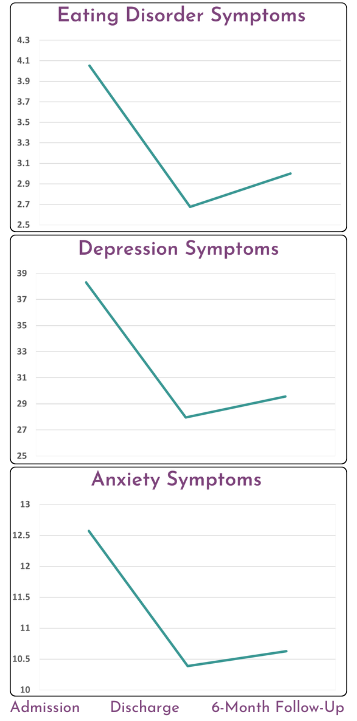
These findings suggest that treatment gains extended beyond discharge, supporting lasting recovery.
Looking Beyond Symptoms
Recovery involves more than reducing eating disorder behaviors.
Published in Eating Disorders: The Journal of Treatment and Prevention, a second study examined whether treatment also changed several underlying psychological processes that contribute to eating disorders.
Key Findings:

Experiential avoidance, helping individuals become more willing to experience difficult thoughts and emotions rather than avoiding them.
Anxiety sensitivity, reducing fear of emotional and physical distress.

Mindfulness, strengthening present-moment awareness and emotional regulation.
These improvements were also maintained six months after treatment, suggesting that the UTM helps address not only symptoms but also the emotional processes that contribute to long-term recovery.
Why This Research Matters
Together, these studies provide complementary evidence that The Renfrew Center’s Unified Treatment Model addresses both:
- the symptoms of eating disorders and co-occurring conditions such as anxiety and depression, and
- the underlying psychological mechanisms associated with eating disorder development and recovery.
This growing body of evidence supports the UTM as a transdiagnostic, evidence-based treatment approach that can effectively serve diverse patient populations.
Published in Peer-Reviewed Journals
These findings were published in respected peer-reviewed journals, meaning the research underwent independent scientific review before publication.
Long-Term Effects of the Unified Treatment Model for Eating Disorders and Comorbidity with BIPOC Clients
Counseling Outcome Research and Evaluation (Association for Assessment and Research in Counseling)
Examining the Effects of a Transdiagnostic Treatment Model on Anxiety Sensitivity, Experiential Avoidance, and Mindfulness in Black, Indigenous, and People of Color with Eating Disorders
Eating Disorders: The Journal of Treatment and Prevention
Learn More About Renfrew Research
Research has been central to The Renfrew Center’s mission for more than four decades. Our Research Department continually evaluates treatment outcomes to improve patient care and contribute to the broader understanding of eating disorders.